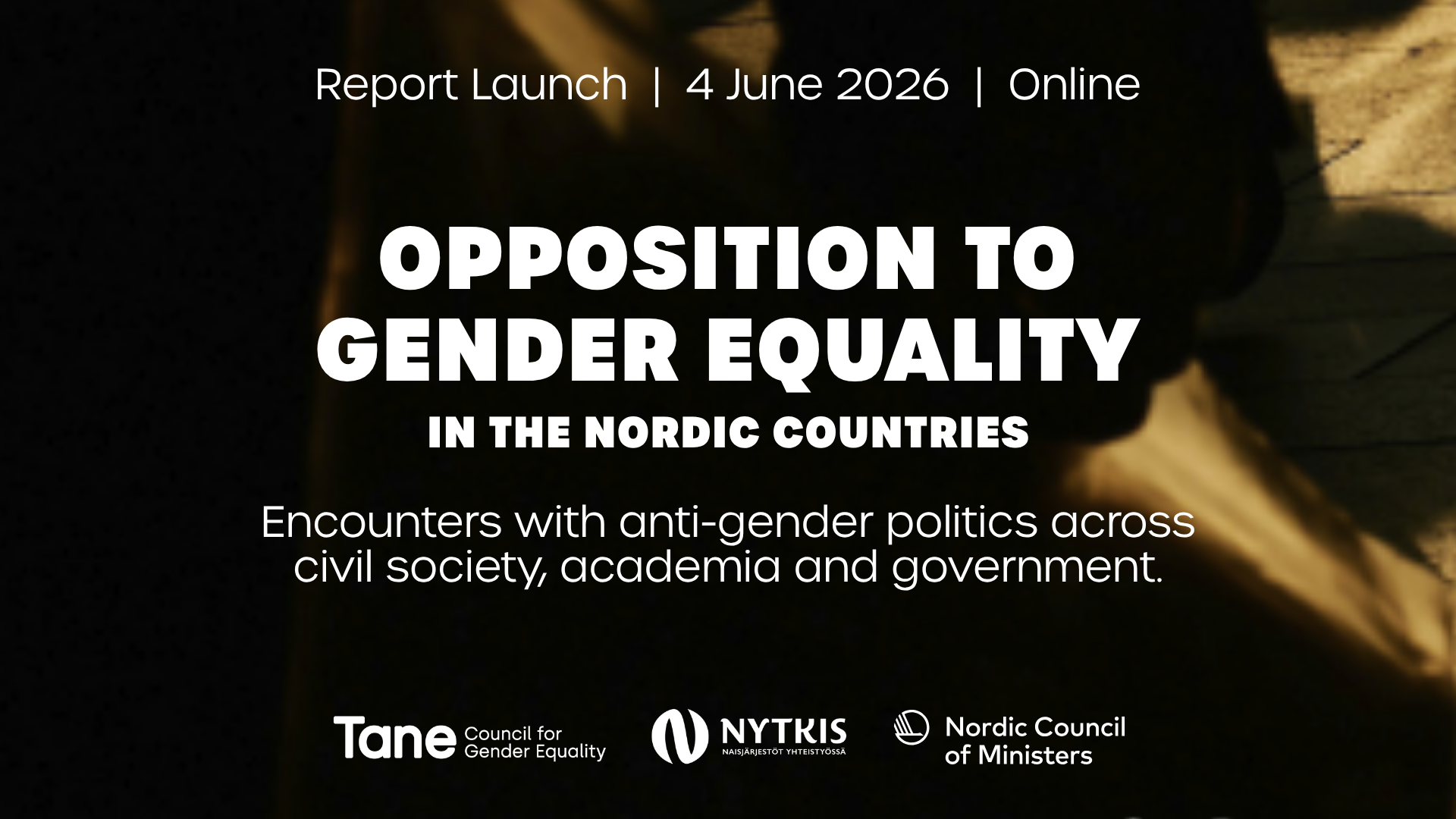
Date: Thursday 4 June 2026
Time: 13:00-14:15 (GMT +3)
Location: Online
Recent research points to growing, coordinated opposition to gender equality, sexual and reproductive health and rights (SRHR), and LGBTQI+ rights across Europe, yet its effects on practitioners remain under-researched. This study offers an initial assessment of the extent, forms, and impacts of such opposition in the Nordic countries.
Welcome to the Report Launch Event! Please register via the link below by 2 June at the latest.
The event is organised by The Council for Gender Equality in Finland (Tane) and the Coalition of Finnish Women’s Associations (NYTKIS). The report and launch event is funded by the Nordic Council of Ministers.
Title: Opposition to gender equality in the Nordic countries. Encounters with anti-gender politics across civil society, academia and government.
Author: Associate Professor (title of docent) Julian Honkasalo, University of Helsinki
The report provides an initial assessment of the extent and impact of opposition encountered in gender equality advancement work and LGBTQI+ rights advocacy in the Nordic countries. The report explores key questions such as:
The report is based on a qualitative online survey conducted among public officials, civil society organisations, and academics working on gender equality issues across the Nordic region.